FXI Studio Research · Pre-registered study · Version 1.1
Automatic Checks Overrate the Cheapest AI Video Model: A Pre-Registered Cost and Quality Study
- Authors
- FXI Studio Research
- Published
- · Version 1.1 · Study ID
fil-model-study-2026-10-14 - Pre-registration
- Protocol committed (commit
3186a4c), before any study clip was generated - Conflict of interest
- FXI Studio publishes this study and sells every model tested in it. The data are published so anyone can check the numbers.
Abstract
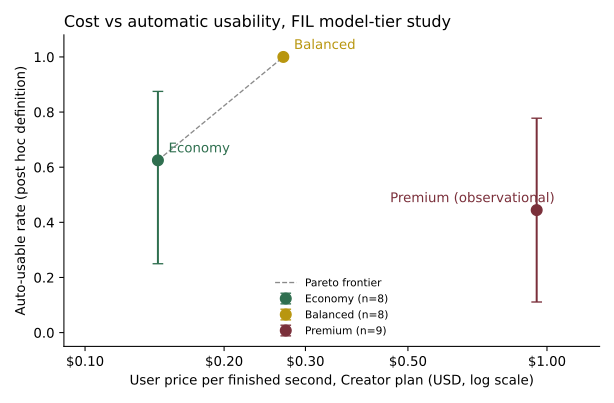
We compared three price tiers of AI video models on four shot types from a short live-action-style drama, starting every clip from the same approved still. The study was pre-registered before any clip was generated. Economy (P-Video, $0.14 per finished second on the Creator plan) and Balanced (Grok Imagine Video 1.5, $0.27) each produced 8 clips; a Premium arm (Seedance 2.5, $0.95) is observational. Automatic checks (speech recognition, OCR, cut detection, first-frame similarity) passed 5 of 8 Economy clips and 8 of 8 Balanced clips. A blinded rater accepted 3 of 8 Economy clips and 8 of 8 Balanced clips (mean rating 2.5 vs 3.9 out of 5). Per human-usable second, Balanced costs $0.27 and Economy $0.38. Automatic checks overrated the cheapest tier, and should not route production on their own. The evidence is narrow: one film, one rater who is also the publisher, two clips per cell.
Economy
$0.38
per human-usable second
P-Video · 3 of 8 usable
Balanced
$0.27
per human-usable second
Grok Imagine Video 1.5 · 8 of 8 usable
Opens the studio with the study’s settings: 9:16, 4 seconds, 720p, from a still you approve. You can change the model at any time.
1Methods
1.1 Material and shots
Footage came from Faithful in Little, a three-part 9:16 faith drama. Four shots were chosen to cover the main shot types of narrative coverage. Every condition started from the same approved first-frame still (Nano Banana 2.1, 3 credits, counted in every price).
| Code | Shot type | Scripted line |
|---|---|---|
| D | Single-speaker dialogue | “If those brakes go, it’s on both of us.” |
| T | Two-person touch and a line | “He that is faithful in that which is least…” |
| M | Big camera move (pull back and rise), silent | None |
| E | Silent establishing wide | None |
1.2 Conditions
Economy: P-Video. Balanced: Grok Imagine Video 1.5. Premium: Seedance 2.5, planned on D and T. All clips: first frame = the approved still, no end frame, 4 seconds, 720p, 9:16, sound on, one prompt per shot identical across conditions. Two replicates per cell (seeds 101401 and 101402), 16 Economy and Balanced clips in total. The Premium arm could not run as registered and was replaced by observational data (see Deviations).
1.3 Automatic outcomes (pre-registered)
- Word error rate on D and T: whisper.cpp
small.entranscript against the scripted line. - Burned-in text: Tesseract OCR on 8 frames, every positive checked by eye.
- Model-inserted cut: ffmpeg scene score above 0.4 after frame 0.
- First-frame fidelity: SSIM between frame 0 and the input still.
- Auto-usable: no burned-in text, no inserted cut and, on dialogue, a word error rate of 0.
- Cost per finished second: (credits charged + 3 for the still) ÷ 4 s, at the Creator plan rate of $0.025 a credit. Cost per usable second divides that by the usable rate.
1.4 Human rating
One rater (the operator) scored all 16 Economy and Balanced clips from 1 to 5 on realism, motion, identity, artifacts (5 = none) and, for dialogue, lip-sync, plus usable yes or no. Clips were shown by letter only, at full resolution; the key was applied after all 16 ratings were saved.
1.5 Analysis
Means with 95% percentile bootstrap intervals (10,000 resamples); exact binomial intervals for rates. With two clips per cell, intervals are reported only at the condition level, and per-shot values are descriptive. No p-values.
2Automatic results
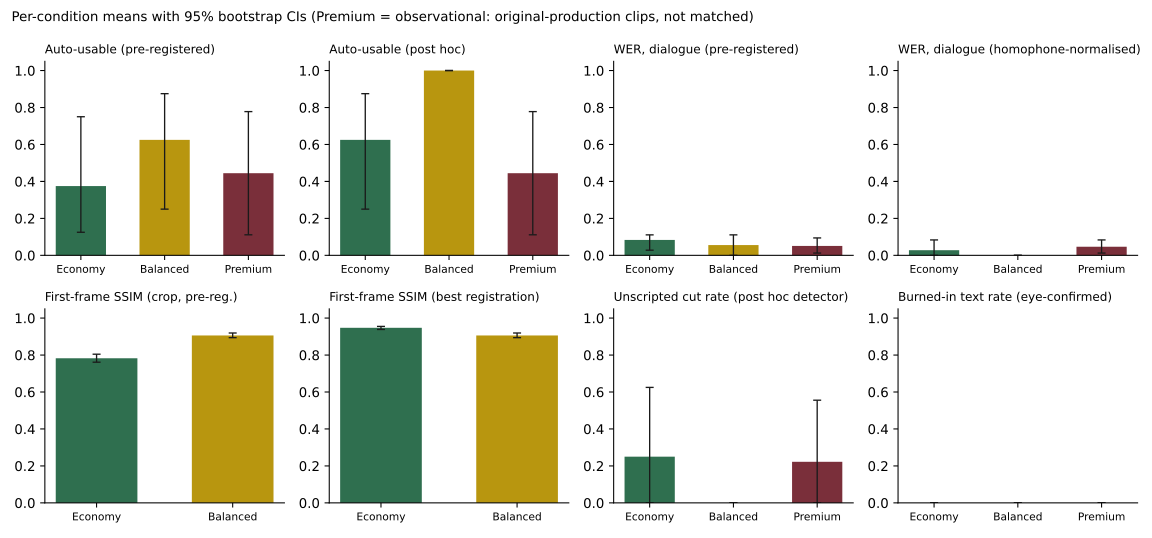
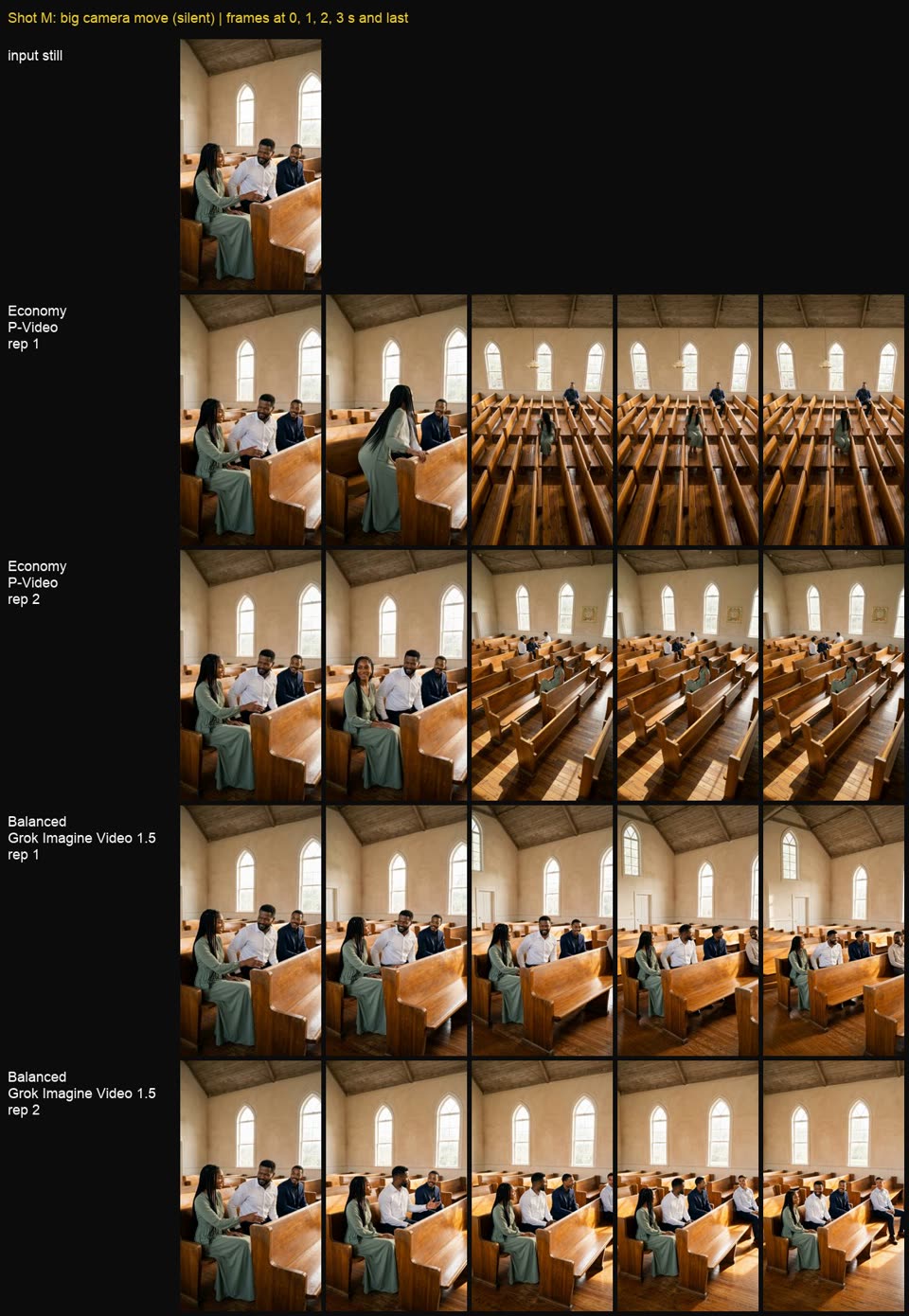
By the automatic checks alone, the cheapest tier looked good enough for most shots: P-Video passed every check on the dialogue single and the silent wide. It failed the camera move, replacing it with a hard cut in 2 of 2 clips. Grok Imagine Video 1.5 passed all 8 clips, but invented spoken lines on the silent move shot (2 of 2), so its audio must be muted there. Burned-in text appeared in 0 clips; four OCR flags were all false on inspection.
| Measure | Economy · P-Video (n=8) | Balanced · Grok 1.5 (n=8) | Premium · Seedance 2.5 (n=9, obs.) |
|---|---|---|---|
| $ per finished second, Creator plan | $0.14 | $0.27 | $0.95 |
| $ per finished second, Visionary plan | $0.08 | $0.15 | $0.53 |
| Auto-usable, pre-registered | 0.38 (0.13 to 0.75) | 0.63 (0.25 to 0.88) | 0.44 (0.11 to 0.78) |
| Auto-usable, post hoc | 0.63 (0.25 to 0.88) | 1.00 (1.00 to 1.00) | 0.44 (0.11 to 0.78) |
| Word error rate, dialogue | 0.083 (0.028 to 0.111) | 0.056 (0.000 to 0.111) | 0.051 (0.013 to 0.094) |
| Word error rate, homophone-normalised | 0.028 (0.000 to 0.083) | 0.000 (0.000 to 0.000) | 0.047 (0.013 to 0.083) |
| First-frame SSIM, crop (pre-reg.) | 0.78 (0.76 to 0.80) | 0.91 (0.89 to 0.92) | n/a |
| First-frame SSIM, best registration | 0.95 (0.94 to 0.96) | 0.91 (0.89 to 0.92) | n/a |
| Unscripted cut (post hoc detector) | 0.25 (0.00 to 0.63) | 0.00 (0.00 to 0.00) | 0.22 (0.00 to 0.56) |
| Burned-in text, eye-confirmed | 0 of 8 | 0 of 8 | 0 of 9 |
| Unscripted speech on silent shots | 0 of 4 | 2 of 4 | 0 of 1 |
| $ per auto-usable second | $0.23 | $0.27 | $2.14 |
Table 1. Means with 95% bootstrap intervals. Rates are fractions of clips. Premium clips are long multi-line takes from the original production, so the Premium column is not a matched comparison.
Per shot (auto-usable, of 2)
| Shot | Economy | Balanced |
|---|---|---|
| D · dialogue single | 2 | 2 |
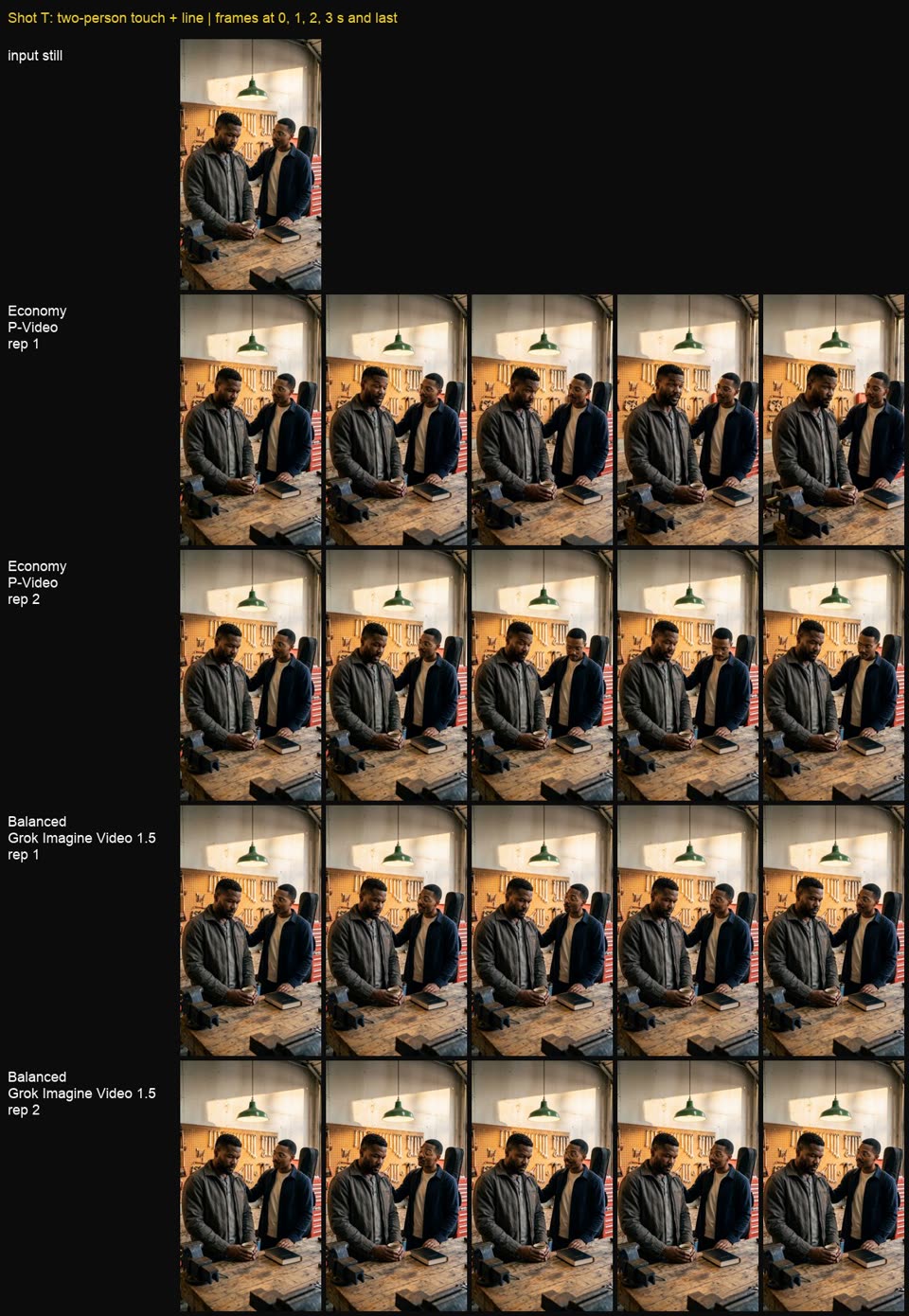
| T · touch and a line | 1 (said “and” for “in”) | 2 |
| M · camera move | 0 (hard cut at 1.25 s and 1.29 s) | 2 (unscripted speech) |
| E · silent wide | 2 | 2 |
3Human rating reverses the automatic result
The rater accepted 8 of 8 Grok Imagine Video 1.5 clips (exact 95% interval 63% to 100%) and 3 of 8 P-Video clips (9% to 76%). The automatic checks had passed 5 Economy clips. Priced per human-usable second, Balanced costs $0.27 and Economy $0.38: the cheaper model per second is the dearer one per usable second.
| Rating (1 to 5) | Economy · P-Video | Balanced · Grok 1.5 |
|---|---|---|
| Usable (rater) | 3 of 8 (9% to 76%) | 8 of 8 (63% to 100%) |
| Mean, all dimensions | 2.5 (1.9 to 3.0) | 3.9 (3.4 to 4.4) |
| Realism | 2.1 | 3.5 |
| Motion | 2.3 | 3.8 |
| Identity | 2.8 | 3.9 |
| Artifacts (5 = none) | 2.9 | 4.4 |
| Lip-sync (dialogue, n = 4 each) | 3.3 | 4.8 |
| $ per finished second | $0.14 | $0.27 |
| $ per human-usable second | $0.38 | $0.27 |
Table 2. Blinded operator rating, 16 clips. Bootstrap 95% intervals for means, exact binomial for usable rates.
By shot (mean rating; usable of 2)
| Shot | Economy | Balanced |
|---|---|---|
| D · Single-speaker dialogue | 3.0 (1) | 4.1 (2) |
| T · Two-person touch and a line | 3.4 (2) | 4.8 (2) |
| M · Big camera move, silent | 1.4 (0) | 3.0 (2) |
| E · Silent establishing wide | 2.3 (0) | 3.8 (2) |
What the rater saw
P-Video audio was described as grainy or “crunchy, digitized” on 3 clips, and one dialogue take had an abrupt head turn. On the church camera move both P-Video clips broke the pews and seating. Grok clips were described as clear-voiced with realistic motion; its one recurring fault was adding an unscripted extra person on the move shot (2 of 2, both still rated usable).
The automatic checks catch burned-in text, inserted cuts and wrong words. They do not see audio texture, scene coherence or where bodies are placed. Automatic gates alone should not route production.
4Hypotheses
| Hypothesis (as registered) | Verdict |
|---|---|
| H1. Economy-first routing reaches ≥ 90% of Premium’s mean rating at ≤ 25% of its cost. | Not testable. Premium was not matched or rated. On cost alone, Economy routing is 15 to 28% of Seedance 2.5. |
| H2. Economy is auto-usable on ≥ 75% of clips. | Not supported: 38% pre-registered, 63% post hoc, 38% by the rater. |
| H3. Balanced’s word error rate on dialogue is ≤ Economy’s. | Supported: 0.056 vs 0.083; rater lip-sync 4.8 vs 3.3. Intervals overlap. |
| H4. Premium costs ≥ 6× Economy and is not more often auto-usable. | Supported on cost (6.6×). Usability 4 of 9 vs 5 of 8, unmatched. |
5What to use
The revised routing makes Balanced the default. Prices are FXI Studio user prices on the Creator plan; Visionary is about 0.56× these.
| Template | Model per shot | $ / finished s | $ / usable s |
|---|---|---|---|
| Balanced (default) | Grok Imagine Video 1.5 on every shot, from an approved still. Mute its audio on silent shots. | $0.27 | $0.27 (rater) |
| Economy | P-Video for drafts and animatics where the audio is replaced; re-roll freely. Grok Imagine Video 1.5 for big camera moves. | $0.14 | $0.38 (rater) |
| Premium | Seedance 2.5 for hero sequences: multi-shot takes from reference images and long dialogue runs. | $0.95 | Not rated |
6Limitations
- One rater, who is also the publisher. A second, independent rater is needed before citing the per-shot figures.
- Two clips per cell. One film, one genre, four shot types. With n = 8 a single clip moves a rate by 12.5 points, and every interval is wide.
- Imperfect blinding. The rater may have recognised a model’s audio signature; one note named it.
- Premium is observational and unmatched. Its clips used different prompts, inputs, durations (4 to 26 s) and cut structure, so they cannot show what Seedance 2.5 would do on these four shots.
- Automatic measures are proxies. Word error rate mixes recognition errors with real line errors; SSIM on frame 0 measures fidelity to the still, not realism; OCR raised false alarms; neither cut rule is perfect.
- Prices change. All prices are FXI Studio user prices on 14 October 2026 (Creator $0.025 a credit, Visionary $0.014).
- No face processing. No face-recognition or face-embedding model was used and nothing was edited in post.
7Deviations from the pre-registration
- Premium arm replaced by observational data. The four planned Seedance 2.5 clips failed at dispatch because the model does not accept a seed; one identical retry also failed, and a third call without the seed hit a spend-window limit. None were charged. The arm instead uses the original production’s 9 Seedance 2.5 generations at the credits they were charged.
- Homophone-normalised word error rate (post hoc). Whisper writes the scripted “brakes” as “breaks”, which failed every D clip under the strict rule. Both measures are reported.
- First-frame SSIM with best registration (post hoc). P-Video stretches the still instead of cropping it; registered the way the model used the image, its SSIM reads 0.95 instead of 0.78.
- Frame-difference cut detector (post hoc). The scene-score rule missed three cuts that are plain to the eye. A cut is now any frame whose mean grey-level change exceeds 25/255.
- Unscripted speech on silent shots (added after seeing the data). It surfaced when Grok invented lines on shot M.
- Not measured: generation latency, and whether the models honour seeds.
Total spend: 540 credits against a 1,200-credit cap (16 study clips at 480 credits, plus one 60-credit re-roll outside the study).
8Data and code availability
Released under CC BY 4.0. Video files are not redistributed.
- generations.csv: every clip, every automatic measure, user price.
- summary.json: condition and cell summaries with intervals.
- human_ratings_summary.json: all 16 blinded ratings and their summaries.
- Pre-registration: the protocol as committed at 2026-10-14 13:22:15 UTC.
- Contact sheet, shot T and shot M.
The analysis code (metrics, cut detection, bootstrap, ratings) is kept in FXI Studio’s repository and is available on request from the authors.
9How to cite
APA
FXI Studio Research. (2026, October 14). Automatic Checks Overrate the Cheapest AI Video Model: A Pre-Registered Cost and Quality Study (Version 1.1). FXI Studio. https://www.fxi.studio/research/ai-video-cost-quality-study
BibTeX
@techreport{fxi2026costquality,
  title       = {Automatic Checks Overrate the Cheapest AI Video Model: A Pre-Registered Cost and Quality Study},
  author      = {{FXI Studio Research}},
  institution = {FXI Studio},
  number      = {fil-model-study-2026-10-14},
  year        = {2026},
  month       = oct,
  note        = {Version 1.1. Pre-registered 2026-10-14 13:22:15 UTC, commit 3186a4c},
  url         = {https://www.fxi.studio/research/ai-video-cost-quality-study}
}
Version history
- 1.1 · 14 Oct 2026 · Blinded human ratings added; they reverse the automatic headline.
- 1.0 · 14 Oct 2026 · Automatic outcomes, Premium observational arm.
- 0.0 · 14 Oct 2026, 13:22 UTC · Protocol pre-registered.
Related: AI video model benchmark 2026 (speed and success rate on production jobs) and the AI video cost calculator.